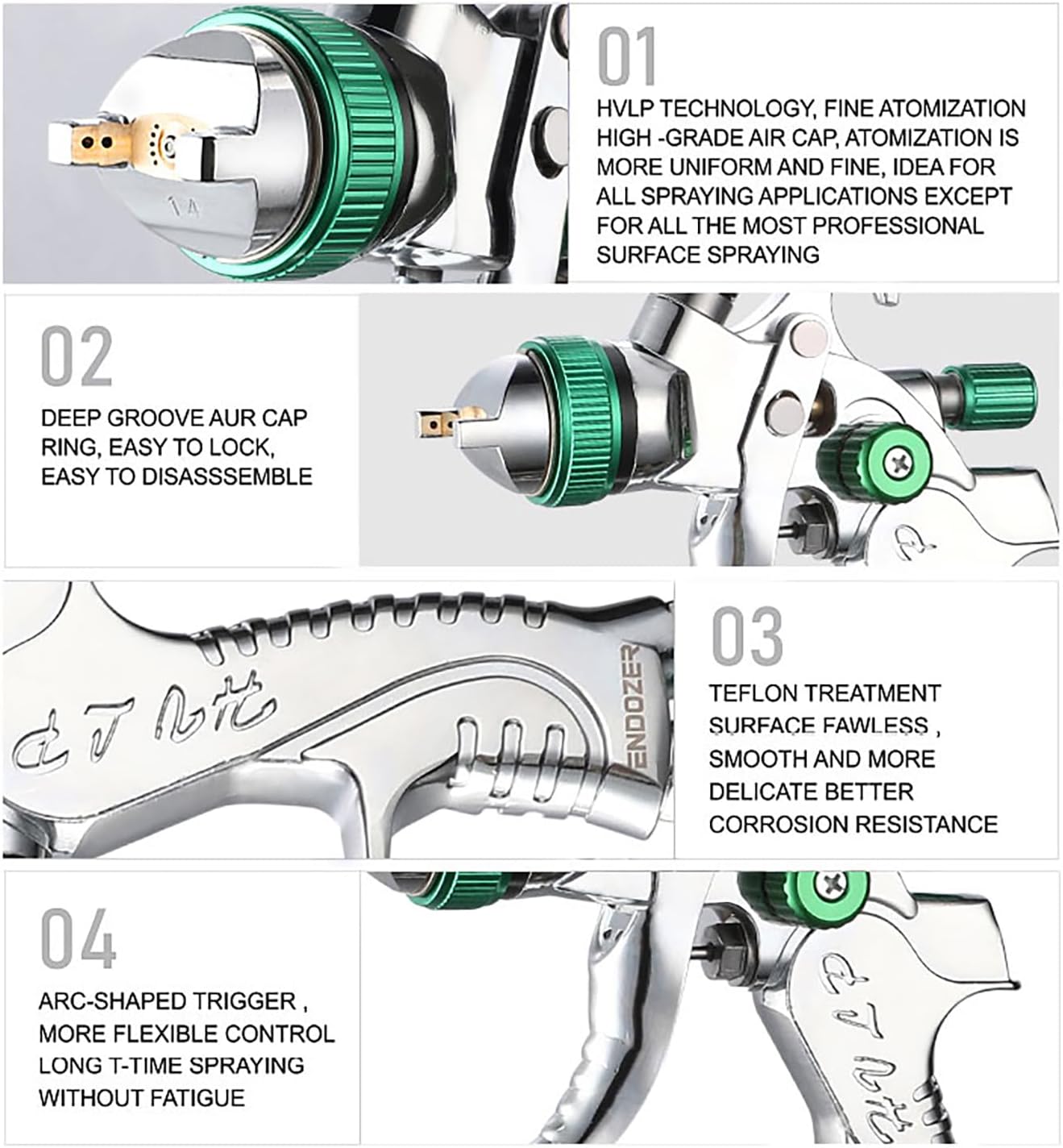
If you’re new here: an HVLP spray gun (High Volume, Low Pressure) is the tool that atomizes — breaks apart and delivers — liquid paint onto your car panel as a fine, even mist. The “gravity-feed” part means the paint cup sits on top of the gun, using gravity to pull material into the airstream instead of forcing it from below with a pressurized siphon. That design gives you better control at lower air pressures, less overspray waste, and a softer finish right out of the gun. It’s become the default setup for everyone from first-time garage painters to shop-level professionals. What you’ll get from this guide: a clear comparison of the four tiers of gravity-feed HVLP guns available in 2026, honest tradeoffs between each, the spec differences that actually change your results, and a decision rule at the end so you can stop researching and start spraying.
If you’re already past the “what is HVLP” stage, here’s the harder truth: most mid-level painters stall on this purchase because the spec sheets all look similar, the price gap between tiers is significant, and nobody wants to leave money on a gun they’ll outgrow in six months — or worse, buy cheap and spend that savings correcting a uneven finish. This article is for that exact moment: gun in hand (figuratively), credit card nearby, trying to make the call that doesn’t haunt you three sprays in.
The Four Tiers — What You’re Actually Paying For
The gravity-feed HVLP market in 2026 stacks into four distinct price bands. The differences between them aren’t just badge prestige — they show up in real output metrics and long-run reliability.
By the Numbers:
| Tier | Typical Price Range | Needle/Nozzle Sets | Air Requirement (CFM) | Expected Service Life |
|---|---|---|---|---|
| Entry (Hobby) | $25–$65 | 1 fixed | 4–6 CFM | 30–80 spray hours |
| Mid-Range (Prosumer) | $80–$180 | 1–2 included | 6–9 CFM | 150–400 spray hours |
| Semi-Pro | $200–$450 | 2–3 included | 8–12 CFM | 500–1,500 spray hours |
| Professional | $500–$900+ | Full set + extras | 12–18 CFM | 2,000+ spray hours |
CFM = Cubic Feet per Minute of compressed air, which your compressor must sustain to feed the gun properly.
The number that quietly kills more garage paint jobs than any other is CFM demand. A mid-range gun rated at 8 CFM needs a compressor that can sustain 8 CFM — not just peak at it. Most homeowner-grade pancake compressors peak at 3–4 CFM sustained. Pair a semi-pro gun to an undersized compressor and you’ll get pressure drops mid-panel, leading to dry, textured patches that have to be blocked out and re-shot. I-CAR’s 2024 training materials flag sustained CFM mismatch as one of the top three equipment-related causes of rework in hobby and prosumer setups.
Needle Size, Fan Width, and Why They’re Not Interchangeable
The two specs that directly control finish quality — and that reviews gloss over most — are needle/nozzle diameter and fan pattern width.
Needle/nozzle diameter determines what viscosity of material flows correctly. Measured in millimeters:
- 1.3–1.4 mm: The sweet spot for clearcoats and basecoats at standard reducer ratios. This is the setup you want for 95% of automotive topcoat work.
- 1.5–1.8 mm: Heavier materials — high-build primers, sealers, single-stage urethanes at heavier viscosity.
- 1.0–1.2 mm: Ultra-fine work — candy concentrates over a base, detail work on small panels, tinting interiors.
House of Kolor technical documentation explicitly recommends a 1.3–1.4 mm tip for their Kandy Koncentrates when reduced to standard application viscosity, and a 1.5 mm tip when shooting their KD Series Dry Ground Metallic basecoats unreduced. Shooting the wrong tip size with those materials either produces excessive orange peel (too large) or tip blockage and spatter (too small).
Fan pattern width — how wide the spray oval is at your working distance — matters most for full-panel work. A 10–12 inch fan at 6–8 inches from the panel lets you cover a door in efficient parallel passes without overlapping too aggressively or leaving dry edges. Entry guns frequently max at 8–9 inches. That’s workable for a hood scoop repair; it’s exhausting for a full-quarter respray.
Hot Rod Magazine’s 2024 spray gun buyer’s guide makes a point that experienced painters tend to confirm in long-run reviews: the adjustment knobs (fan, fluid, and air pressure controls) are where cheap guns fall apart faster than the spray tip itself. Reviewers of sub-$60 guns consistently report that the fan-width adjustment screw strips or loses tension repeatability before 50 spray hours — meaning you set your pattern at the start of a job and pray it holds.
The Three Guns Worth Serious Consideration in 2026
Rather than listing every brand, here’s a decision-focused comparison of three guns that appear consistently at the top of aggregated reviews and published spec comparisons for garage and semi-pro use.
DeVilbiss FLG-5 (Mid-Range, ~$130–$160)
The DeVilbiss FLG-5 is a gravity-feed HVLP that occupies a well-documented sweet spot. Published specs put it at a 1.3 mm tip standard (1.5 available), 10-inch fan pattern, and roughly 7.5 CFM demand. MotorTrend’s 2025 DIY finishing tool roundup cited it as a benchmark for this price tier. Owners in long-run reviews consistently report that the fluid needle stays true well past 200 spray hours with basic cleaning discipline — running reducer through the gun at the end of every session rather than letting material dry in the passages.
Who it’s for: Painters doing 2–8 full-panel resprays per year, spraying standard basecoat/clearcoat systems, and running a compressor that sustains 7+ CFM. At this volume and scale, the cost-per-panel math for the FLG-5 is hard to beat.
Real tradeoff: The cup threads on the FLG-5 are reported by multiple owners as inconsistent seal on aftermarket cups. Stick with the OEM cup or verify thread compatibility before buying a second gravity cup for color changes.
SATA Jet 5000 B HVLP (Semi-Pro, ~$550–$650)
SATA’s Jet 5000 B is the gun most shop painters reference when asked what they’d buy if they were starting a side business. Autobody News’ 2025 transfer efficiency review cites HVLP guns in the SATA 5000 class at 65–70% transfer efficiency (the percentage of atomized material that lands on the panel vs. becoming overspray). Published specs: 1.3 mm standard tip, 10–12 inch fan, 11.5 CFM demand, and a micrometer-style fluid needle adjustment that is significantly finer than the knob-based systems on mid-tier guns.
Who it’s for: Painters doing 15+ jobs per year, shooting premium materials (BASF Glasurit, PPG Envirobase, House of Kolor top-tier lines), and running a two-stage compressor that sustains 12+ CFM. If you’re billing clients or entering shows, the finish consistency over 500+ spray hours justifies the price differential.
Real tradeoff: Genuine SATA guns require genuine SATA parts. Needle sets, nozzles, and air caps are not cross-compatible with other brands the way some mid-tier guns are. Long-run cost of ownership includes those consumables.
TCP Global Brand 1.4 mm Gravity Feed HVLP (Entry-to-Mid, ~$35–$55)
TCP Global’s house-brand gravity guns consistently appear in the practical recommendations of refinishing instructors working with students on budget constraints. Published specs are modest — 1.4 mm tip, approximately 5–6 CFM demand, fan pattern to 10 inches — but owners doing single-panel touch-ups and small repair work report usable results when air supply is matched correctly and material is reduced to the low end of the manufacturer’s viscosity range.
Who it’s for: First resprays, learning pattern control, spraying single panels with Rust-Oleum Automotive or Dupli-Color 2K products where marginal atomization quality is compensated by proper reducer selection and technique. Not the right choice for metallics, pearls, or candy-layer work where atomization consistency is load-bearing.
Real tradeoff: At this price point, treat it as a consumable, not an investment. Owners report inconsistent manufacturing tolerances — two guns of the same model can spray differently out of the box. Budget for the possibility that your unit may need tip adjustment or replacement within 30 spray hours.
The Compressor Question You Have to Answer Before Buying the Gun
The EPA’s surface coating compliance guidelines (updated 2023) set HVLP transfer efficiency requirements at or above 65% for regulated facilities — but the downstream practical effect is that compliant HVLP guns are designed to run at lower atomization air pressure (typically 8–12 PSI at the air cap) compared to conventional guns. That low cap pressure is what makes HVLP transfer-efficient — and it’s also what makes sustained CFM supply critical. The gun is not building pressure; it’s consuming volume.
The practical decision tree:
- Sustain under 6 CFM: Entry gun only. Anything larger will pressure-starve.
- Sustain 6–9 CFM: Mid-range guns work correctly. Semi-pro guns will drop pressure mid-pass.
- Sustain 10+ CFM: Semi-pro and professional guns perform as rated.
Run our Mix Ratio Calculator to dial in your reducer percentage before you set gun pressure — a too-thick mix causes painters to crank fluid flow past the needle’s optimal range, which accelerates tip wear and creates runs.
If X, Then Y — The Decision Rule
After working through the specs and the aggregated owner feedback, here’s the honest framework:
If you’re spraying 1–5 panels per year with standard mid-tier materials: The DeVilbiss FLG-5 at ~$150 is the one to buy. It’s what I’d recommend to a friend standing in the aisle asking me to just tell them. The build quality sustains through a realistic hobby volume, and the 1.3 mm tip handles 95% of basecoat/clear work correctly.
If you’re doing semi-regular client work, shooting premium systems, or both: The SATA Jet 5000 B earns its price in finish consistency and long-run reliability. The cost-per-panel math over 500+ hours of work brings it in line with mid-tier guns that wear out in a fraction of the time.
If you’re learning pattern control on a tight budget: The TCP Global entry gun gets you moving. Treat it as tuition, not equipment.
In every case: Match the gun to your compressor’s sustained CFM first. A mismatched compressor will cost you more in rework than the price difference between any two guns on this list. Check our Reducer & Hardener Ratio Chart before your first spray session and the Pot Life Cheat Sheet before you mix — those two resources will save you from the mistakes that cost more than the gun itself.