If you’ve ever stood in the automotive paint aisle staring at forty identical-looking cans and wondered which one will actually hold up on your car — you’re in the right place. A rattle can (the industry nickname for a pressurized aerosol spray can) is the most accessible paint delivery system on the market: no spray gun, no compressor, no mixing cups. Single-stage means the color and the protective clearcoat chemistry are combined in one product, so there’s no separate clearcoat step. That simplicity is genuinely useful for small repairs, accent pieces, and budget whole-car resprays — but only if you pick the right can and apply it with a little discipline. This guide is for garage painters who already know the basics and are trying to make a smarter product choice. You’ll get a ranked comparison of the top aerosol lines, honest tradeoff math, and a clear decision rule at the end so you know exactly which can to reach for.
Why Single-Stage Aerosols Still Matter in 2026
Let’s be honest about what a rattle can is and isn’t. It isn’t a replacement for a two-stage basecoat/clearcoat system shot through a professional HVLP gun — not on a show car, not on a client’s daily driver. What it is, in the right hands, is a genuinely capable finishing tool for:
- Precise touch-up work on chips and small door dings (under 3 inches)
- Full panel resprays on low-visibility panels (underside of hoods, inner fenders, engine bays)
- Full-car budget resprays on work trucks, project cars, and off-road rigs where longevity matters more than depth of gloss
- Interior trim and detail work where flexible-adhesion formulas matter
The single-stage aerosol market has genuinely matured since 2022. Auto Body News reported in March 2025 that aerosol paint sales in the automotive refinishing segment grew approximately 12% year-over-year, driven by OEM color-match SKU expansion and improved resin technology. The gap between a $12 hardware-store can and a $22 professional aerosol like Dupli-Color Perfect Match or SEM ColorCoat is now measurable in adhesion performance, color accuracy, and VOC compliance — not just marketing.
The Rankings: Four Tiers That Actually Make Sense
Tier 1 — Best Overall for OEM Color Match: Dupli-Color Perfect Match Premium
Dupli-Color’s Perfect Match line is the default recommendation for anyone doing a color-matched repair on a production vehicle, and it’s earned that position. The product line covers over 20,000 factory paint codes (referenced against the Dupli-Color 2025 cross-reference database, Illinois Tool Works), uses acrylic lacquer over a urethane-modified resin base, and ships in a 8-oz can with a comfort-grip wide-spray tip that meaningfully reduces orange peel on horizontal surfaces.
The honest tradeoffs: Acrylic lacquer shrinks as it fully cures — plan on 30 days before wet-sanding. Gloss retention over 18–24 months in direct UV exposure is moderate. Dupli-Color’s own technical bulletin rates the product at approximately 350–400 sq. inches of coverage per can at proper mil thickness (1.5–2.0 dry mils), which works out to roughly 60–70% of a standard door panel per can.
Cost-per-panel math: At a 2026 retail average of $10–$14 per 8-oz can, and 2–3 cans per full door panel, you’re looking at $20–$42 per panel before prep materials. Run this through the VehiclePaints.com Cost-Per-Panel Calculator to check against your specific panel size and target mil build.
Who it’s for: Anyone with a factory paint code doing cosmetic touch-ups or single-panel color matching on a daily driver. This is what I’d point a first-timer toward.
Tier 2 — Best for Durability and Engine Bay Work: Rust-Oleum Automotive Series
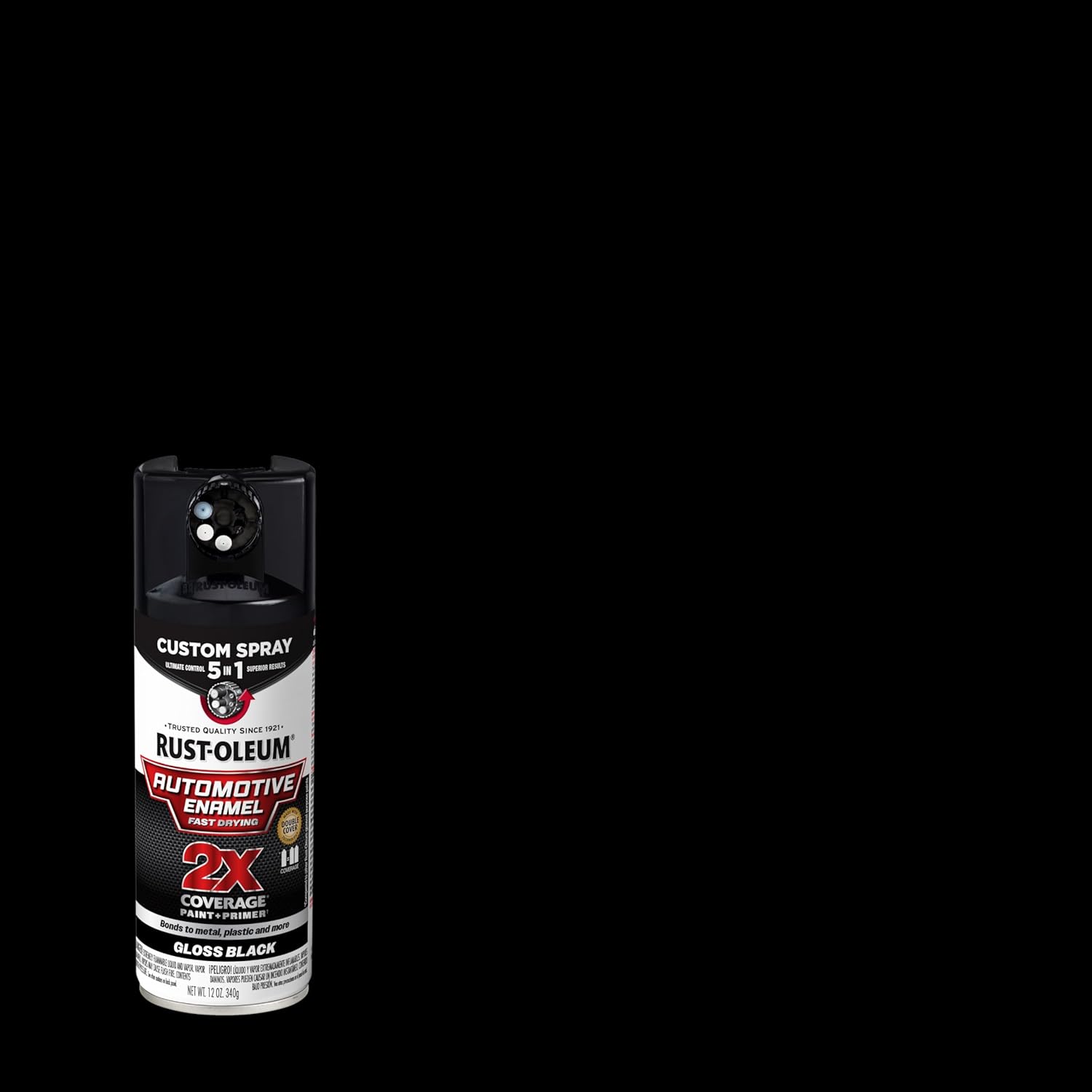
Rust-Oleum Automotive’s aerosol line — specifically the 2-in-1 Filler & Sandable Primer and the High-Performance Enamel topcoats — is the workhorse of garage resprays for a reason. The high-performance enamel uses an alkyd resin formula that Rust-Oleum’s 2025 product data sheet rates at 50+ MEK rubs (a standard measurement of cure hardness; more rubs = harder, more solvent-resistant film). That beats most acrylic lacquer aerosols by a significant margin and makes it genuinely appropriate for engine compartments, frames, and surfaces that see heat cycling.
The honest tradeoffs: Alkyd enamel dry times are slower than lacquer — Rust-Oleum specs a 2–4 hour recoat window and a full 7-day cure before the film reaches rated hardness. Hot Rod Magazine’s January 2025 roundup of budget aerosol systems consistently cited Rust-Oleum’s long cure window as the primary pain point for weekend builds. Color selection is also limited to approximately 40 standard automotive shades; this is not an OEM color-match product.
Cost-per-panel math: At $8–$12 per 12-oz can and stronger coverage rates (Rust-Oleum specs approximately 12–15 sq. ft. per can at standard application), panel cost drops to $16–$28 for a full door panel. Use the VehiclePaints.com Cost-Per-Panel Calculator with the 12-oz can setting.
Who it’s for: Project cars, work trucks, frames, suspension components, and engine bays. Any surface where you need a hard film more than a color match.
Tier 3 — Best for Flexible Substrates and Trim: SEM ColorCoat Aerosol
SEM Products occupies a niche that most general-purpose aerosols can’t touch: flexible vinyl, plastic trim, and soft-touch interior surfaces. SEM’s ColorCoat aerosol uses a vinyl/urethane hybrid formula that SEM’s 2024 specification guide rates for adhesion to unprimed flexible substrates — a claim that holds up across aggregated professional reviews on autobodynews.com. For any job involving bumper covers, door trim, dashboards, or soft-top components, SEM is the category-specific answer.
The honest tradeoffs: ColorCoat is a specialty product, not a universal topcoat. It’s not rated for exterior horizontal surfaces receiving prolonged direct sunlight as a standalone system. It requires SEM’s own adhesion promoter aerosol as a prep step on unpainted plastics, adding $8–$12 to the per-panel cost. Color-matching requires using SEM’s mixing code system, which is more complex than scanning a factory color code.
By the numbers — SEM ColorCoat vs. standard aerosol on flexible substrates:
| Metric | Standard Acrylic Aerosol | SEM ColorCoat |
|---|---|---|
| Adhesion to bare flex plastic | Poor (peels within 6 months, per aggregated owner reports) | Excellent (rated per SEM spec guide) |
| Flexibility (per manufacturer spec) | Brittle at <40°F | Passes 180° bend test |
| Average retail per can (2026) | $10–$14 | $18–$24 |
| Coverage per can | ~60–70% of a door panel | ~50–60% of a bumper cover |
Who it’s for: Interior refinishing, bumper covers, vinyl trim, any flexible substrate. This is the specialist, not the generalist.
Tier 4 — Best for Show Accents and Custom Spot Work: Rust-Oleum Custom Coat / Specialty Series
Rust-Oleum’s Custom Coat line, including their metallic and specialty-effect aerosols, has gotten genuine traction in the custom builder community for accent panels, motorcycle tanks, and small-batch decorative work. The metallic variants use a fine-particle aluminum and mica base that owners consistently report delivers a mid-level metallic depth — not a House of Kolor concentrate, but notably above commodity-store metallics. The canned comfort-grip tip system also shows up in Hot Rod’s aerosol coverage as a meaningful ergonomic upgrade for detail work.
The honest tradeoffs: This is a specialty/accent product, not a full respray system. Gloss and metallic pop require a compatible aerosol clearcoat overcoat (Rust-Oleum’s own 2x Crystal Clear works well on top of it per manufacturer recommendation). Expect to add $8–$12 per can for clearcoat coverage, and consult the VehiclePaints.com Pot Life Cheat Sheet before deciding whether to clear same-day or after a full 24-hour flash.
Who it’s for: Custom accent panels, engine covers, motorcycle tanks, interior metallic details.
VOC Compliance: The Rule That Changes Your Options by State
This is the constraint most garage painters discover too late. The EPA’s National VOC Emission Standards (40 CFR Part 59) set a federal ceiling for aerosol coating VOC content, but California’s South Coast AQMD and several other state/regional air quality districts impose significantly stricter limits. As of 2026, California, Oregon, and parts of the Northeast prohibit the sale of aerosol automotive topcoats above 250 g/L VOC.
Practical impact: Dupli-Color Perfect Match runs approximately 600–700 g/L VOC in standard formulation. The compliant version sold in California (“CARB compliant” on the label) uses a different resin system and covers slightly fewer sq. inches per can. If you’re ordering online and shipping to a regulated state, verify the label. Auto Body News flagged in their March 2025 coverage that several major retailers were shipping non-compliant aerosols to California customers, creating warranty and resale complications for professional shops.
Check the epa.gov Architectural and Industrial Maintenance Coatings database for the current compliant product list by category.
Decision Rules: If X, Then Y
Here’s the framework. Match your situation to the right product — and don’t overthink it.
If your goal is OEM color-matching a production vehicle for cosmetic repair: → Dupli-Color Perfect Match. Find your factory paint code (driver’s door jamb sticker or VIN decoder), match it to the Dupli-Color cross-reference, and budget 2–3 cans per panel.
If you’re respraying a work truck, frame, or engine bay and need hard-film durability over perfect color: → Rust-Oleum Automotive High-Performance Enamel. Accept the 7-day cure window. It will outlast any lacquer on those surfaces.
If the surface is plastic, vinyl, or flexible: → SEM ColorCoat, full stop. No other aerosol in this tier has tested adhesion specs on flex plastic. Don’t use a rigid-resin paint on a bumper cover and expect it to hold.
If you’re doing custom metallic accent work on a show build: → Rust-Oleum Custom Coat metallic series + compatible aerosol clear. Check reducer ratios and flash times against the VehiclePaints.com Reducer & Hardener Ratio Chart before layering.
If you’re in a VOC-regulated state (CA, OR, parts of the Northeast): → Verify CARB compliance on the label before ordering. Don’t assume the standard SKU ships compliant.
The rattle can doesn’t have to be a compromise — it just has to be the right can for the right surface, prepped correctly, applied in the right conditions. Get that alignment right, and a $40 aerosol respray can look like real money well spent.
Check the VehiclePaints.com Cost-Per-Panel Calculator and Mix Ratio Calculator before you finalize your can count — both are free and built specifically for aerosol and spray-gun applications.