If you’ve spent any time planning a full panel respray or a multi-stage custom build, you’ve probably run into the term clearcoat — the final transparent layer sprayed over your color that gives the finish its gloss, depth, and protection from UV and weather. Clearcoat isn’t just a topcoat you slap on; the chemistry matters. The hardener you pick (the reactive agent that crosslinks the clear and makes it cure solid) controls how fast you can sand, polish, recoat, or deliver a job. Get it wrong and you’re either waiting two extra days for a slow-cure clear to harden enough to compound, or you’re watching a fast-cure clear gas out in your spray gun mid-panel because the shop hit 88°F before noon.
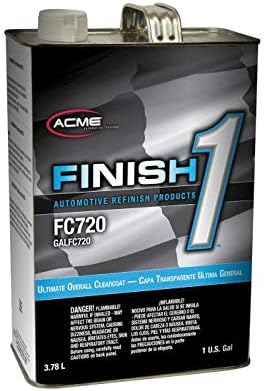
This article is about one specific clearcoat system that sits right at the crossroads of professional access and mid-level budget: Sherwin-Williams Finish 1 FC720 Ultra Productive Clearcoat. We’ll break down the hardener speed options, show the exact mix ratios, work through real panel-cost math, and give you a clear framework for deciding which hardener grade fits your conditions. If you have a job on deck — or you’re comparing FC720 against other systems before you pull the trigger — this is the decision guide you need.
What FC720 Actually Is (And Where It Sits in the Market)
FC720 is a two-stage urethane clearcoat, meaning it requires mixing a base component (the clear resin) with a separate hardener (also called an activator or catalyst) and optionally a reducer (solvent that adjusts viscosity and spray characteristics) before use. Once mixed, a chemical reaction starts immediately — which is why “pot life” (the window during which the mixed product flows and atomizes properly) is a live concern, not a theoretical one.
Sherwin-Williams positions the FC720 within its Finish 1 line as the workhorse professional clear for production shops and serious garage builders who want reliable gloss and a smooth flow-out without paying BASF Glasurit or PPG DC5000 prices. Autobody News’ 2025 annual refinishing report notes that mid-tier clears like FC720 have taken significant market share from premium OEM-spec systems in the independent shop segment, largely because compliant chemistry at this price point has matured enough to close the quality gap on standard production work.
The FC720 system uses the FC700-series hardeners, and that’s where most of the decision-making lives.
Hardener Speeds: Slow, Medium, Fast — and When Each One Is Right
The FC720 is designed to work with three hardener grades: FC705 (slow), FC710 (medium), and FC720H (fast). The product data sheet published by Sherwin-Williams Automotive Finishes specifies distinct working parameters for each, and choosing wrong is one of the most common reasons painters get orange peel, solvent pop, or a clear that won’t polish out.
Here’s how to think about it:
FC705 — Slow Hardener
- Designed for: High-temperature environments (75°F–95°F ambient), or large-panel/full-vehicle work where you need maximum flow time.
- Pot life (per Sherwin-Williams PDS): Approximately 45–60 minutes at 70°F.
- Recoat window: Manufacturer data puts force-dry-ready time (at 140°F bake) around 20–25 minutes; air-dry dust-free around 30–40 minutes at 70°F.
- Best application: Full hood, roof, or complete vehicle sprays where you’re making multiple passes and need the clear to stay open (wet) long enough for each coat to melt into the last.
If you’re working in a booth that runs warm or you’re doing a concours-level full respray where flow-out and leveling matter more than speed, this is the grade worth reaching for.
FC710 — Medium Hardener
- Designed for: The 60°F–80°F range. The all-rounder.
- Pot life: Approximately 30–45 minutes at 70°F per the published spec sheet.
- Recoat window: Dust-free around 20–30 minutes air-dry; force-dry-ready faster with bake.
- Best application: Single panels, two-panel jobs (door + quarter, for example), or full jobs in a temperature-controlled booth.
The FC710 is what most shops default to. It’s forgiving enough to handle mild temperature swings, fast enough to keep production moving, and the finished surface’s clarity reviews well across aggregated user reports on refinishing forums and professional product evaluations.
FC720H — Fast Hardener
- Designed for: Cold conditions (50°F–65°F) or situations where you need to cut cure time aggressively.
- Pot life: Drops to approximately 20–30 minutes at 70°F — meaningfully shorter.
- Recoat window: Can be ready for polishing significantly faster in cold environments.
- Risk: In warm conditions, this hardener accelerates the reaction so fast that the clear can skin over before it levels. Orange peel, micro-blistering, and a grainy surface are the tell-tale failure modes.
PPC Pro’s technical reference on urethane pot life variables explicitly flags temperature as the dominant accelerant — each 18°F rise roughly halves the usable pot life of a fast hardener. If your shop is 75°F and you mix FC720H, you may have a usable window closer to 15 minutes. That’s not a lot of time on a full door.
Mix Ratios: The Numbers That Matter
Per the Sherwin-Williams Automotive Finishes FC720 product data sheet, the standard mix ratio is:
4 parts FC720 : 1 part hardener (FC705, FC710, or FC720H) : up to 1 part reducer (optional)
By the numbers:
- Clear : Hardener : Reducer = 4 : 1 : 0 to 1
- Pot life range across hardener grades: ~20 min (fast, warm) to ~60 min (slow, cool)
- VOC as supplied: approximately 3.5 lbs/gallon (check local district compliance before purchase)
- Coverage estimate: 1 mixed quart ≈ 2–3 medium panels at standard application thickness
A note on reducer: the FC720 PDS lists reducer as optional but recommends it in hot conditions or when spraying through an HVLP gun calibrated for higher-viscosity materials. Adding reducer extends the pot life slightly and improves atomization at the gun, but it also increases your material cost and can affect gloss if over-reduced. The I-CAR technical reference on clearcoat chemistry notes that reducing beyond 25% by volume consistently risks a measurable drop in film build and final gloss, particularly with urethane systems formulated for lower reducer ratios like this one.
Always confirm your local VOC district rules before sourcing. Some air quality management districts have lower VOC caps than the federal EPA threshold. The EPA’s published standards for automotive refinishing VOCs are a baseline, not a ceiling — regional rules in California (SCAQMD) and other metro districts are frequently stricter.
Use the Mix Ratio Calculator on this site to dial in your exact volumes before you pour — it removes the arithmetic error risk and shows you total mixed volume so you’re not short mid-panel.
Real-World Panel Cost: Running the Math
Pricing fluctuates, but as of mid-2026, FC720 is generally available through Sherwin-Williams Automotive branches and authorized jobbers in the $80–$120 per quart range for the clear base, with hardeners running $30–$50 per pint separately. Kits (clear + hardener bundled) typically run $110–$160 per quart-kit depending on region and distributor relationship.
Let’s build a realistic cost-per-panel breakdown for a common scenario: full door respray (approximately 12–16 sq ft) with two clearcoat coats.
| Item | Qty Used | Estimated Cost |
|---|---|---|
| FC720 clear base (quart kit) | ~10–12 oz | ~$35–$45 |
| FC710 hardener | ~2.5–3 oz | ~$10–$15 |
| Reducer (optional, pint) | ~2 oz | ~$5–$8 |
| 400/800/1500 grit sand + compound | per panel | ~$6–$12 |
| Total per door panel | ~$56–$80 |
That’s a realistic mid-range number for material cost only — labor and booth time are your variables. For a 5-panel respray (both doors, two quarters, hood), expect to consume a full quart kit plus additional hardener, landing material cost in the $200–$280 range before prep consumables.
Compare that to PPG DC5000 or BASF Glasurit 923-240 clearcoats, which Autobody News’ refinishing report places in the $160–$240 per quart kit tier. FC720 undercuts meaningfully on material cost while landing within a close margin on documented gloss and hardness ratings in the PDS specs. For production work or multi-car customer jobs, that delta compounds quickly.
Check the Cost-Per-Panel Calculator on this site to model your exact scenario — it accounts for mix ratios, panel count, and waste factor, which is the number most painters forget to budget for.
Reducer Ratios, Pot Life, and Application Windows
One area where practitioners frequently get caught is treating pot life as a fixed number. It isn’t. Per the Sherwin-Williams PDS and confirmed by PPC Pro’s analysis of urethane variables, pot life is a function of three overlapping inputs: hardener grade, ambient temperature, and reducer volume.
The practical rule:
- No reducer + fast hardener + 80°F booth = you may have 12–18 minutes before viscosity climbs out of sprayable range. Plan your panel sequence and don’t mix until the gun is set up and you’re ready to shoot.
- Full reducer allowance + slow hardener + 65°F booth = 60+ minutes is realistic. Suitable for a complete vehicle with multiple trips around the car.
The Finish 1 Reducer & Hardener Ratio Chart (available in the tools section of this site) maps these variables in a grid format so you can cross-reference your shop temperature against your hardener choice before you mix anything.
The Decision Framework: If X, Then Y
Here’s the clear-cut guidance based on what the specs and aggregated practitioner experience support:
- If your shop runs above 80°F consistently: Use FC705 (slow) and consider adding reducer at the upper end of the allowance. Don’t gamble on medium hardener in heat you can’t control.
- If you’re in a temperature-controlled booth at 65°F–75°F doing 1–3 panel jobs: FC710 (medium) is your default. It’s the least risky grade for the widest range of conditions.
- If you’re in a cold shop (under 65°F) or working in winter without heat: FC720H (fast) earns its place — but only if the temperature is actually cold. If it warms up mid-job, you’ll feel it in the pot life immediately.
- If you’re comparing FC720 to a premium clear for a show-quality build: The cost difference is real and meaningful across multiple panels. For production and daily-driver restores, FC720 is a defensible choice based on published specs. For a concours restoration where the clearcoat is the last layer anyone will ever see and polish is worth 40 hours of labor, the incremental investment in a premium system is worth the conversation.
- If you’ve never mixed this system before: Start with a test panel. Mix a small batch at your planned ratio, shoot it on scrap, and time the flash and cure against what the PDS predicts. The chemistry behaves predictably — the learning curve is in reading your specific conditions, not in the product itself.
Bookmark the Pot Life Cheat Sheet here for mid-job reference. Knowing exactly how much working time you have left — without guessing — is the difference between a smooth second coat and a rushed pass that shows in the final polish.