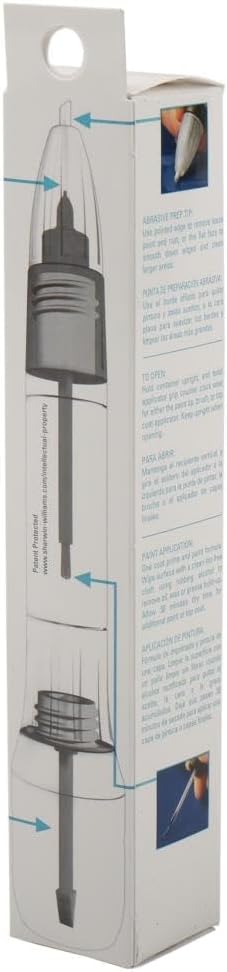
You just found a chip on your hood — maybe a pebble strike on the leading edge, maybe a door ding with a raw-metal center. It’s small enough that you’re not pulling the panel, but it’s definitely going to rust if you leave it. A touch-up paint pen (a small, marker-style applicator pre-loaded with factory-matched paint) sounds like the obvious fix. And it is the right tool for this job — but only when you match three things correctly: the paint code (the factory color identifier stamped somewhere on your car), the formula type (single-stage, basecoat, or urethane), and the finish layer on top. Get any one of those wrong and you’ll end up with a repair that’s more visible than the original chip. This guide walks you through exactly how to choose the right pen, what the labels actually mean, and where people consistently go wrong — so your repair disappears instead of broadcasting itself.
Why Touch-Up Pens Fail (And It’s Usually Not the Product)
The most common complaint across aggregated reviews — and the one Car and Driver’s January 2026 buyer roundup flagged most prominently — is “it doesn’t match my car’s color.” In almost every documented case, the mismatch traces back to one of three root causes, not a defective pen.
Root cause 1: Wrong paint code. Your OEM color code is not the color name. “Midnight Blue” might be four completely different formulas across four model years. The code (something like Honda’s “B-92P” for Aegean Blue Pearl, or Ford’s “J4” for Carbonized Gray Metalite) is the only reliable identifier. Every reputable touch-up brand — Dupli-Color, PaintScratch, AutomotiveTouchup — builds its database around these codes, not names. The code is typically on a sticker inside the driver’s door jamb, under the hood near the radiator support, or in the trunk area. MotorTrend’s October 2025 how-to guide recommends photographing it before you order anything, because the sticker degrades over time and some codes are only two or three characters long — easy to misread.
Root cause 2: Formula mismatch with your existing finish. If your car left the factory with a waterborne basecoat/clearcoat system (standard on virtually all OEM finishes since the mid-2000s, per BASF Automotive Refinish’s Spectrophotometry and Visual Color Assessment Guide), applying a single-stage enamel pen over it creates a different sheen angle and a different chemical surface — both of which read as a color mismatch even when the pigment formula is technically correct. The correct choice for modern clearcoated vehicles is a basecoat-style pen followed by a clearcoat pen or wand. More on that decision tree below.
Root cause 3: Skipping the clear. Basecoat paint — the color layer under the clear on most cars built after roughly 1995 — is formulated to be covered, not to sit as a finished surface. It lacks UV stabilizers and the cross-linked hardness that clearcoat provides. Owners who apply basecoat touch-up without a clear layer consistently report the repair oxidizing within one to two seasons. I-CAR’s color theory module PT202 makes this explicit: basecoat applied without a topcoat is a temporary repair, not a finished one.
Reading the Label: What the Product Tiers Actually Mean
Touch-up pens exist at three meaningful price and performance tiers. Here’s what separates them.
Tier 1: Dealer-Sourced OEM Pens ($10–$20)
These are the small bottles or pens sold at dealership parts counters, often labeled with the manufacturer’s name and a specific paint code. Formula accuracy is high because the manufacturer maintains the color database, and the paint is typically the same waterborne basecoat chemistry used in factory assembly. The tradeoff: applicator quality is inconsistent (many are simple foam tips that deposit too much material), pot life after opening is short, and clear pens are sometimes sold separately at an additional cost. Per Autobody News’s March 2025 product roundup, dealer pens remain the benchmark for color accuracy on vehicles under five years old — before UV exposure and clear film buildup start shifting the panel’s apparent color away from the factory spec.
Tier 2: Aftermarket Exact-Match Pens ($15–$35)
Brands like Dupli-Color, AutomotiveTouchup, and Langka build pens to order against your paint code. The color formula is mixed from the same OEM color database that shops use — PPG, BASF, and Axalta all license their formulations to these suppliers. Published specs from AutomotiveTouchup indicate a database covering over 50,000 OEM codes across 30+ manufacturers, updated as new model years are released. Applicator quality is generally better than dealer pens — most include a fine-tip precision nozzle and a separate clear pen in the kit. This tier is where most intermediate practitioners should start: the color matching is reliable, the application system is designed for layered application, and the per-kit cost is reasonable relative to the surface area being repaired.
Tier 3: Professional Micro-Repair Systems ($40–$80+)
Products like the Langka Bundle Kit or professional-spec offerings from TCP Global pair a touch-up pen with a blending solution — a mild solvent that feathers the edge of the new paint deposit into the surrounding clear. This matters because the visual “halo” around a touch-up repair is usually a clear-edge artifact, not a color mismatch. Owners using blending solution consistently report significantly less visible repairs versus pen-only application. The tradeoff is technique sensitivity: the blending solvent has a narrow application window (typically 5–10 minutes after the color coat, per manufacturer instructions) and if you apply too much, you risk lifting the surrounding clear. This tier is appropriate when the chip is in a highly visible location — hood center, door face, A-pillar — where a crisp repair edge would be obvious.
The Color-Match Decision Matrix
By the numbers:
| Vehicle age | Paint system | Correct pen type | Clear needed? |
|---|---|---|---|
| 2005–present | Basecoat/clearcoat | Basecoat-formula pen | Yes — separate clear pen |
| 1985–2004 | Single-stage or BC/CC | Confirm on door jamb sticker | Depends on system |
| Pre-1985 | Single-stage lacquer/enamel | Single-stage formula | Usually no |
| Any repainted vehicle | Unknown | Contact prior shop for formula | Confirm before ordering |
The door jamb sticker approach works for factory paint. For repainted vehicles, this is where it breaks down — a prior refinish might be urethane single-stage over an older basecoat system, in which case ordering a factory-code pen gets you the right color but potentially the wrong chemistry. BASF’s Visual Color Assessment Guide recommends a simple check: look at the repair area under raking light. If you see depth — the color appearing to sit under a glassy surface — it’s clearcoated. If the surface looks flat and the color is right at the surface, it’s single-stage.
Application Mechanics: Where Practitioners Go Wrong
Knowing which product to buy only gets you halfway. Autobody News’s March 2025 roundup noted that applicator technique accounts for as much variation in final appearance as product selection. The most consistent failure pattern across owner reviews: applying too much material in a single pass.
Touch-up paint is formulated for thin deposits. The correct technique — described in PPG’s OEM Color Matching Technical Bulletin TB-2024-07 — is to apply in multiple thin coats, allowing 10–15 minutes of flash time (evaporation of carrier solvent, leaving the pigment layer behind) between passes. Three thin coats will fill a 2–3mm chip with less sag risk than one heavy application. For pens specifically, the tip pressure controls flow volume — most precision tips require only light contact with the surface to deposit material. Owners who press hard consistently report runs and thick deposits that sit proud of the surrounding paint surface.
The leveling step — using a product like Langka’s paint chip repair solution or a 3M Trizact finishing process to knock the repaired area flush — is optional for small chips in low-visibility areas and essentially mandatory for chips larger than 4–5mm on panel faces. Without leveling, even a perfect color match reads as a bump under direct light.
If X, Then Y: The Decision Rules
This is where the analysis lands. Based on published specifications, manufacturer documentation, and the consistent patterns across aggregated owner and professional reviews:
If the chip is smaller than 3mm, on a 2005+ vehicle with factory paint, and not in a highly visible primary panel location — then a Tier 2 aftermarket exact-match basecoat pen plus a separate clearcoat pen is the right tool. Order by OEM paint code. Total spend: $20–$35.
If the chip is on a hood, door face, or other high-visibility panel, or is larger than 4–5mm — then step up to a Tier 3 system with blending solution. The incremental cost ($15–$25 over Tier 2) is trivial relative to the visual difference a proper feathered edge delivers.
If the vehicle has been repainted and you can’t confirm the formula — then do not order a touch-up pen until you’ve confirmed the existing system. A color match on the wrong formula chemistry is a guaranteed mismatch.
If the vehicle is pre-1995 or has a single-stage finish (no depth when viewed under raking light) — then a single-stage formula pen is correct, and a clearcoat step is typically not needed or appropriate.
If you’re doing multiple repairs across a panel and the total affected area exceeds roughly 10–15 square inches — then a touch-up pen is no longer the right tool. That’s a respray conversation, and our Cost-Per-Panel Calculator will show you quickly why panel prep and a rattle can or HVLP setup becomes more economical and will look better.
Use our Mix Ratio Calculator if you’re scaling up to a clearcoat wand or bottled clear — getting the reducer ratio right at small volumes is where first-time users consistently go wrong, and the Pot Life Cheat Sheet is the reference to have open while you work.
The right touch-up pen, applied correctly over the right formula, genuinely disappears. The wrong one just adds a second problem to the first. Order by code, layer correctly, clear it — and that chip becomes a non-issue.